
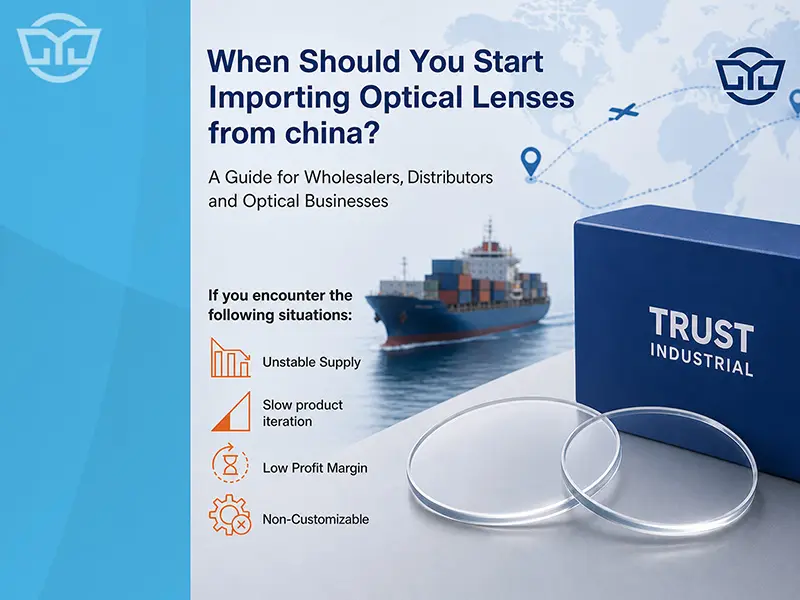
In recent years, more and more optical lens professionals have begun to explore importing lenses from Chinese lens manufacturers.
However, many clients are initially unsure whether importing from China is suitable for them.
This often leads to them discovering, after lengthy discussions with lens factories, that importing is not currently appropriate for their business, resulting in a significant waste of time.
This article will analyze in detail the circumstances under which importing is appropriate from the perspective of Chinese lens suppliers.
As manufacturers, we generally believe that you can begin importing under the following circumstances:
1. Insufficient Profit Margin
This is the most direct reason and one of the most common problems encountered by buyers.
When local purchase prices continue to rise, the buyer’s profit margin decreases significantly. In this case, importing directly from the source factory can be considered.
As manufacturers, we usually price our products at cost, especially when dealing with large quantities.
Factories may even offer discounts to buyers to seek long-term cooperation. Therefore, to obtain a larger profit margin, importing directly from the factory is the best option.
2. Slow Local Product Iteration
In today’s highly competitive market, many chain optical stores and wholesalers seek new products for faster iteration to gain a market advantage.
However, local supplier typically have a much slower product update and iteration speed than source factories. Therefore, importing directly from source factories is a good option.
Lens manufacturers usually allow customers to test new products to obtain market feedback after their release, as this is a crucial time for many lens buyers to gain a market advantage.

3. Unstable Local Supply
Furthermore, unstable local supply is another important factor in seeking direct imports. Lens manufacturers have their own production capabilities and maintain sufficient inventory of many common models.
Therefore, they can usually provide a stable supply and coordinate shipments according to the characteristics of buyer orders. For long-term clients, they can also arrange scheduling and dispatch to meet their urgent orders.
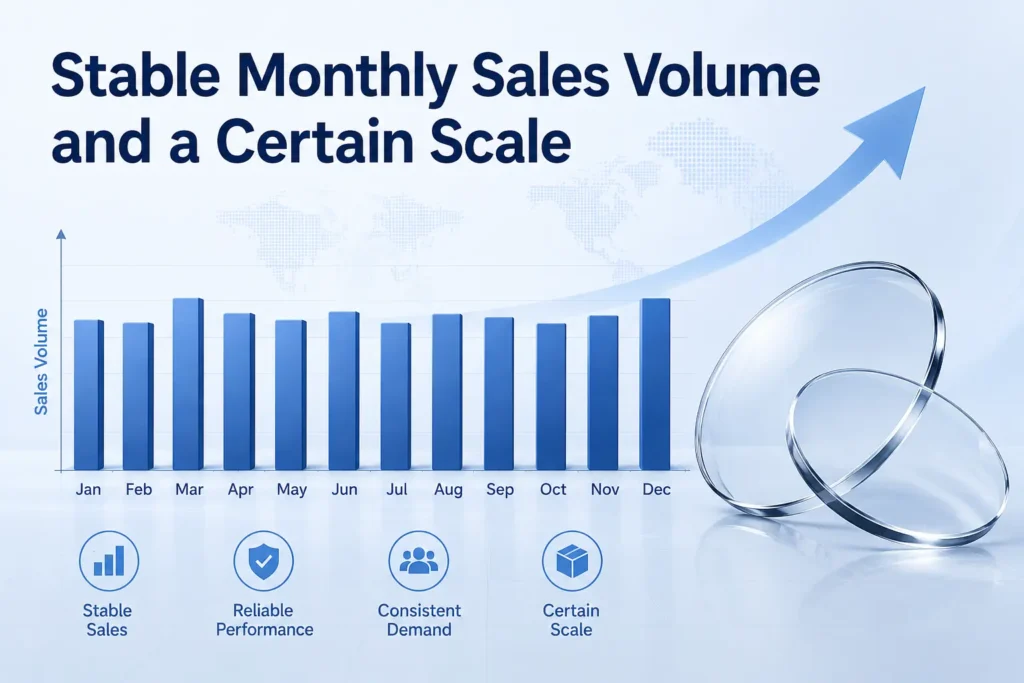
4. Stable Monthly Sales Volume and a Certain Scale
Stable sales volume and a certain scale are key factors for suitable imports, as importing lenses involves costs beyond the lenses themselves, including transportation and tariffs.
While lens manufacturers may offer competitive prices, small quantities, coupled with transportation costs, typically result in an average cost per lens higher than locally sourced ones.
However, larger quantities significantly reduce the average cost of transportation and tariffs.
Therefore, importing in large quantities is more cost-effective. Alternatively, small to medium-sized optical shops may choose to import several months’ worth of lenses at once to reduce overall costs.
5. Building Your Own Brand
For buyers aiming to build their own brand, importing directly from the factory is the best option. Lens manufacturers typically offer ODM & OEM services, allowing for customization to your brand.
This includes custom fog mark on lenses and colorful packaging, as well as special product customizations such as unique coatings and functional combinations.
This provides more comprehensive and professional services for clients building their own brands.

Generally, in the above situations, if your monthly sales volume is more than 500 pairs, direct import from the factory can usually be considered. In the long run, this will be the more suitable option.
For more information on importing and product issues, please contact us for a customized solution.