Photochromic lenses are among the most commonly used lenses, the most common type is photogrey lenses. But do you know what types of photogrey lenses there are?
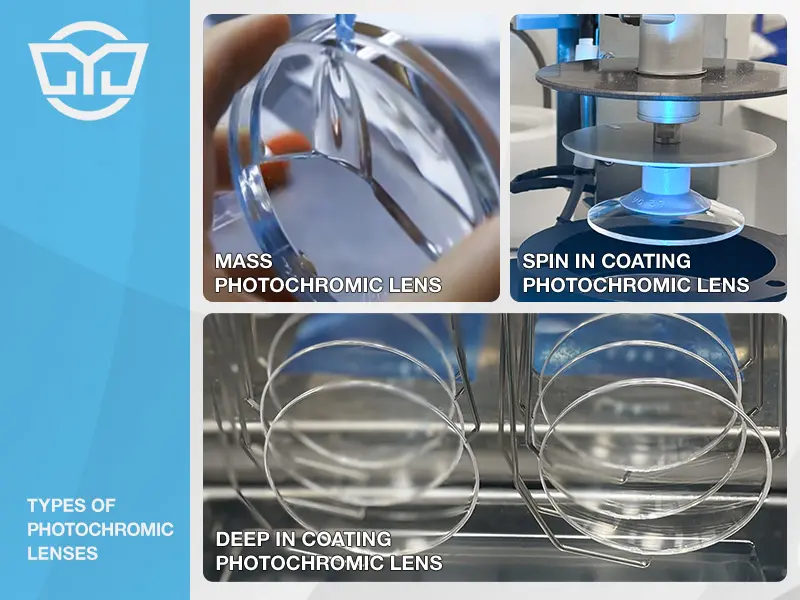
Generally, optical lens manufacturers classify lenses into two types: material photogrey and coating photogrey.
Their manufacturing processes and the location of the photochromic effect differ, resulting in different prices.
Mass photochromic lenses incorporate photochromic molecules into the raw materials used in lens production, causing the lens itself to change color under ultraviolet light, thus achieving UV protection.
Coating photochromic lenses have a photochromic coating applied to the lens surface. This coating changes color under ultraviolet light, providing UV protection.
Depending on the manufacturing process, coating photochromic lenses can be further divided into two types: deep-in coatingphotochromic lenses and spin-in photochromic lenses.
So what are the differences between them?
1. mass Photochromic lens
Advantages: Inexpensive, economical, and currently the most popular choice among users.
Therefore, it is usually in stock, resulting in fast shipping; and its photochromic speed is no slower than that of coating-induced color change.
Disadvantages: Because the entire lens undergoes photochromic changes, the fading speed is relatively slow, and the base color may not fade completely.
Uneven photochromic changes may occur with higher prescription lenses.
2. Deep in Coating Photochromic Lens
Advantages: Inexpensive, uniform color change, and faster fading than material photochromic lenses.
Disadvantages: After lens cutting, the photochromic coating may remain on the lens; Buyers of these types of lenses typically have high price requirements and experience in processing them, and don’t mind this issue.
If you cannot accept the coating residue, it is recommended to choose material photochromic or spin-coated photochromic lenses.
3. Spin-in coating Photochromic Lens
Advantages: Uniform color change, more stable quality; stable color change and fading speed, less likely to leave a base color.
This technology uses the same technology as ESSILOR and TRANSITION, belonging to high-end lenses.
Disadvantages: Higher price.
4. So which one should I choose?
There is no better choice when it comes to lenses, only the most suitable one. The best lens for the customer is the one that meets their needs.
In short: If a user just wants a basic UV protection lens and wants something more economical, they can usually choose a material photochromic lens.
Customers who want slightly higher quality but can afford a slightly higher price can choose an immersion coating photochromic lens.
For customers seeking high-end lenses within their budget, spin-coated lenses are typically the most suitable option.
If you would like to learn more about our lenses or obtain samples for comparison, please contact us immediately.
We will provide you with a customized solution.