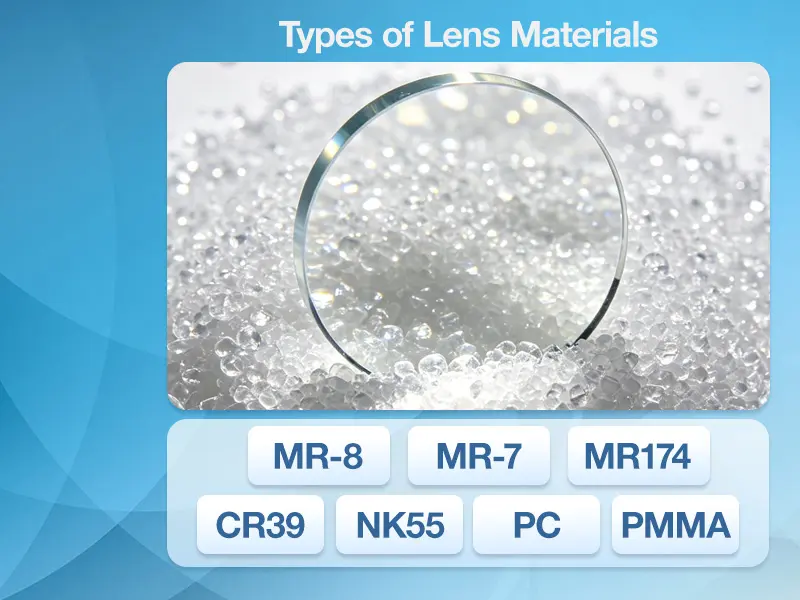
Lens material is equally important for both optical lens manufacturers and buyers. It not only determines the lens’s index but also the applicable scenarios and target audience.
Do you know what lens materials our optical lens suppliers can currently produce?
This article will introduce each material to help lens buyers better understand which material is best suited for them.
1. CR39:
Index 1.49, the highest Abbe number lens. Suitable for single vision lenses and lenses requiring tinting. It’s inexpensive and offers good value.
Note that lenses with prescriptions over +6.00~-6.00 will be relatively thick. It’s considered an economical, basic lens.
2. NK55:
Index 1.56, one of the most commonly used materials.
High clarity, good light transmission, slightly more expensive than CR39. Comfortable visual experience, considered a mid-range lens.
3. Polycarbonate (PC):
Index 1.591, also known as “space lens,” it’s the hardest material of all lenses, with strong impact resistance, widely used in safety, protective, children’s, and sports lenses.
However, it has poor toughness and cannot be perforated.
Note that Poly lenses differ from ordinary resin lenses; they use dry grinding technology during processing.
Furthermore, these lenses are easily scratched and require HC or HMC treatment; they do not have UC.

4. PMMA:
Index 1.60 or 1.61, providing more visual comfort and sharper edges than ordinary 1.56 lenses. The lenses are also thinner and have a wider power range (SPH: +6.00~-10.00). These are considered mid-to-high-end lenses.
5. MR-8:
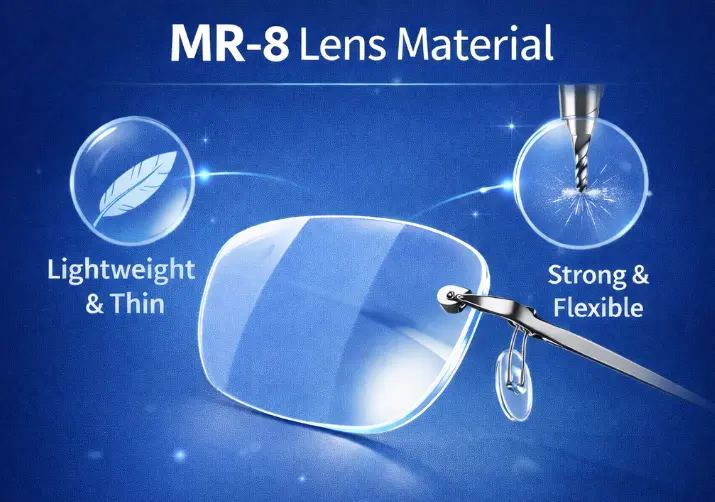
Index 1.60 or 1.61, offering more visual comfort and sharper edges than standard 1.56 lenses. It’s also thinner and has a wider power range (SPH: +6.00 to -10.00).
More importantly, it’s the most resilient of all lenses, suitable for rimless frames and lens drilling. It belongs to the high-end lens category.
6. MR-7:
Index 1.67, suitable for rimless frames. Compared to the previous lenses, it has a wider power range (SPH: +6.00 to -15.00) and is also thinner.
7. MR174:
Index 1.74, currently the highest index lens available. It has the widest power range among stock lenses, only for myopia, not presbyopia. SPH: -0.00 to -18.00, and the thinnest.
For optical product distributors and eyewear brands, choosing the right lens material is not only about performance but also cost-effectiveness and market positioning.
If you are looking for a long term optical lens supplier that can reliably supply different lens materials such as CR-39, Polycarbonate, MR-8 or high index lenses, please feel free to contact us to request samples and obtain OEM/ODM solutions.